How does vitaloop find patterns in what you eat?
Published · Vitaloop Labs
Logging what you eat is easy. Knowing what it means is the hard part. One big day tells you nothing; six Saturdays in a row with more sugar than the rest of the week tell you something. At vitaloop, the nutrition app we build in Barcelona, we have built a system that does exactly that: it looks for what repeats in your data, separates it from the noise, shows it to you only then, and lets the AI reason on top of it.
Why a single day lies
What a person eats changes a lot from one day to the next: a meal out, a birthday, a rushed day. That is why nutrition studies never draw conclusions from a single day of records, and why an app that judges you on today will tell you things that are no longer true tomorrow.
The week does something similar. People eat differently at weekends, have dinner later and sleep differently. Look only at Monday to Friday and you miss half the story; average everything together and the weekend disappears into the mean. A real pattern has to be found by comparing days that are alike.
What counts as a pattern in vitaloop
For vitaloop to show you something as a pattern, three things must hold:
- Enough days. The AI switches on once you have logged 5 of the last 7 days, and a day only counts if you really logged what you ate: a glass of water is not a day of data. Each pattern also asks for the days its own question needs; until it has them, it tells you how many you have.
- Bigger than your noise. Everyone varies in their own way. A difference between two groups of days (short and long nights, weekdays and weekends) only counts if it exceeds your normal day-to-day variation, not some fixed figure that is the same for everyone.
- Honesty when it falls short. If the difference doesn’t clear that bar, the card says so plainly: “not a pattern yet”. The numbers stay visible, but they aren’t highlighted as if they were a finding.
All of this is computed on your phone, with statistics and no generative AI: patterns are numbers, not generated text. The AI comes afterwards.
What it looks like: examples from the demo account
The examples below come from vitaloop’s demo account, “Marc”, which holds sample data, not a real person’s. We read them on 10 October 2026 and have rounded them.
- Weekends. About 2,150 kcal on average on Saturdays and Sundays against about 1,840 on weekdays, and about 66 g of sugars against 44 g. A consistent difference: a pattern.
- Short nights and the next day. After the shorter nights, the next day’s sugars rise to about 63 g, against 45 g after longer nights. That matches the literature: less sleep is associated with eating more (Al Khatib et al., 2017).
- Late dinners and sleep. On nights with a later dinner, the sleep score drops to about 83 out of 100, against 88 on the others (Crispim et al., 2011).
- Salt and weight. Saltier days don’t move next-morning weight any differently from lighter days. vitaloop says exactly that: not a pattern yet. Knowing what doesn’t happen is information too.
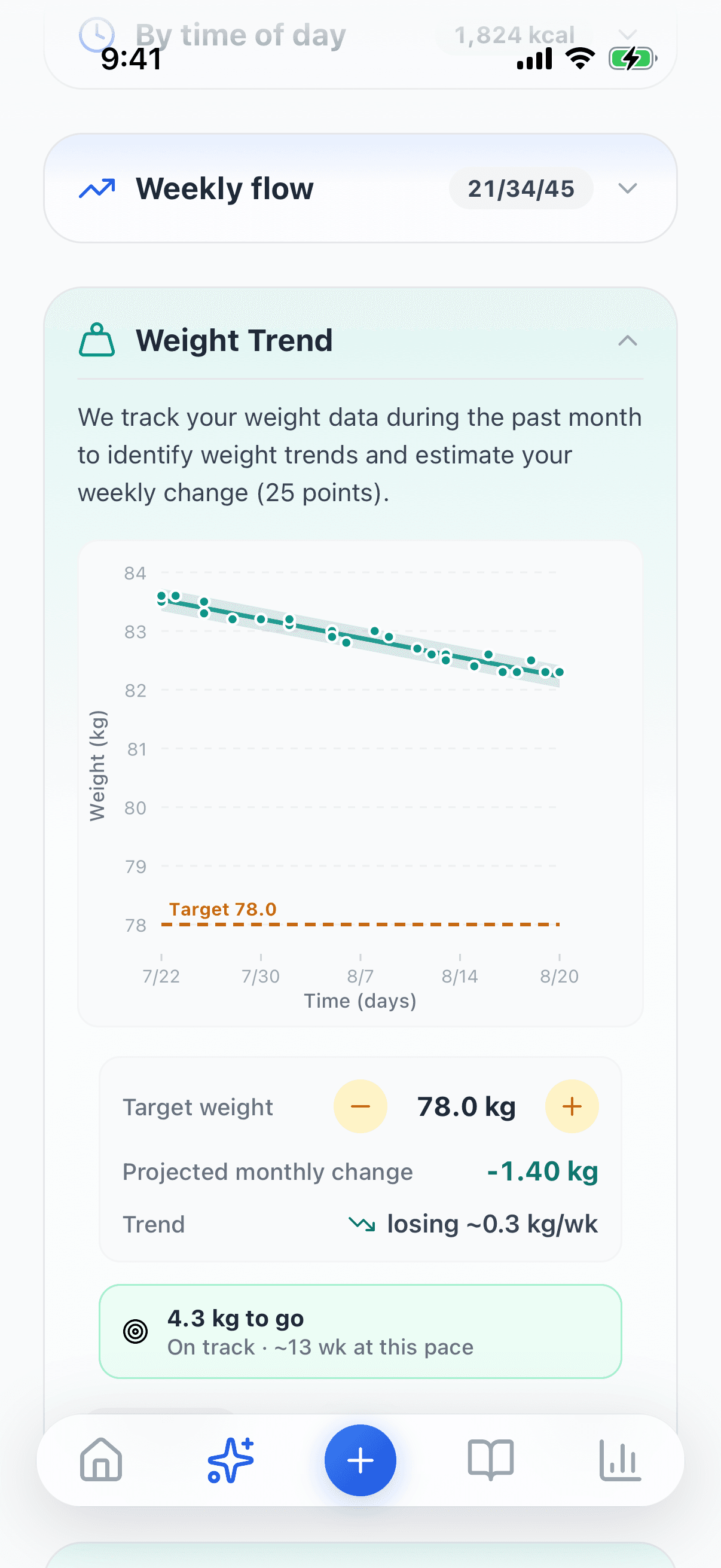
- Weight trend. Instead of today’s number on the scale, a trend line through a month of weigh-ins, with its uncertainty band: about 0.3 kg a week down, and an estimate of how long the goal is at that pace.
From pattern to assistant
This is where vitaloop stops being a calorie counter. Its assistant doesn’t hand out generic nutrition tips: it reasons over your patterns and your targets.
- The weekly report tells you what it saw in your week and proposes one concrete focus. Every suggestion links to the pattern behind it, so you can check it yourself.
- Sources behind every conclusion. Targets come from EFSA reference values for your age and sex, and from WHO guidance on sugars and saturated fat. Practical advice cites published sources, and a citation is only kept if what it says is actually in the source.
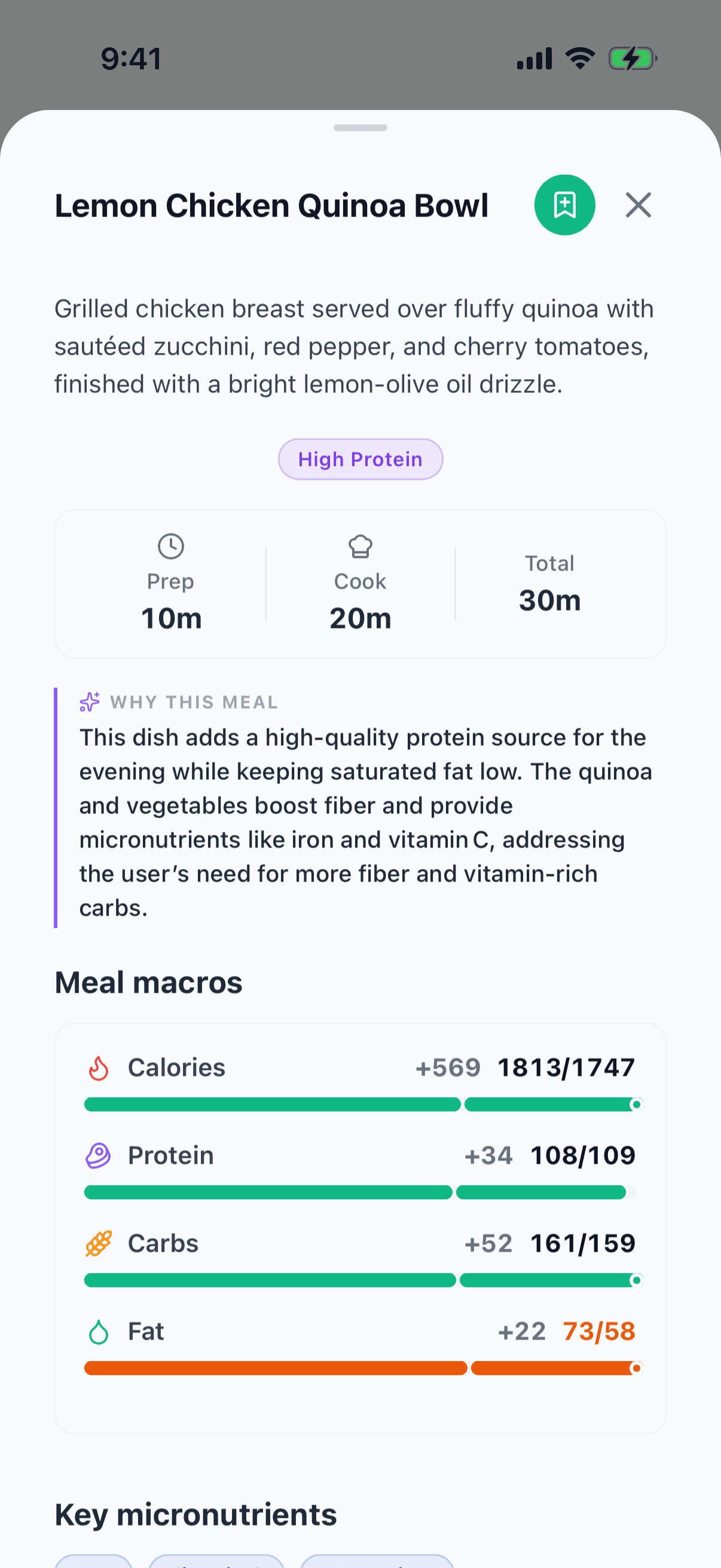
- Meal ideas that start from the vitamins and minerals running below your reference that week, and explain why each dish.
- The chat is the fast way to get your data in right: describe the meal, snap a photo or say it out loud, and it breaks it down into foods and amounts.
And some red lines that are not negotiable: the assistant never recommends a supplement, talks about “below your target” rather than “deficiency”, and makes no diagnoses.
What a pattern is not
- Not a cause. Sleeping worse on nights you eat late doesn’t prove dinner is the cause; maybe you go to bed later on those days for another reason. A pattern is a solid lead for trying a change, not proof.
- Only as good as your log. vitaloop only sees what you record. An incomplete log gives incomplete patterns, which is why the app waits for enough days before it speaks.
- Not a diagnosis. vitaloop is not a medical device. If something worries you, what you see in the app is a good starting point for a conversation with your doctor or a registered dietitian.
So, is vitaloop for you?
If you want an app that goes beyond counting calories, understands how what you eat, how you sleep and how your weight moves relate to each other, and explains it with sources, vitaloop is for you.
It is a free download on the App Store and Google Play. Patterns, the weekly report and meal ideas are part of Pro (€9.90 a month or €49.90 a year, VAT included). Further reading: which app calculates the vitamins and minerals in what you eat, why the label only shows 7 nutrients and vitaloop’s nutrition assistant.
vitaloop is a personal nutrition and data-logging app developed by Vitaloop Labs, SL. It is not a medical device as defined under EU Regulation 2017/745 (EU MDR) and does not constitute professional medical advice. Personalized suggestions are based on your personal data and should not be used as a substitute for advice from a qualified healthcare professional. Nutritional data may contain inaccuracies; always verify critical information on product labels.