Iron: how much you need a day, where to get it and how to tell if you do
Published · Vitaloop Labs
An adult man needs about 11 mg of iron a day; a woman before menopause, 16 mg. Those are the European reference values. Knowing the number is the easy part. Knowing whether you reach it is harder: iron comes in small amounts from many foods, and not all of it is absorbed equally. Below are the official figures, the foods with the most iron in the composition tables we use, what helps you absorb it, and how vitaloop works it out from what you actually eat.
What iron does
Iron sits at the centre of haemoglobin, the protein in red blood cells that carries oxygen from your lungs to the rest of your body, and of myoglobin, which stores it in muscle. It is also part of the enzymes your cells use to get energy out of food; EFSA describes it as necessary for almost every pathway of energy metabolism.
How much iron do you need a day?
In Europe the reference is EFSA’s, published in 2015. It gives two figures for each group: the Average Requirement (enough for half of people) and the Population Reference Intake (enough for nearly everyone). The second is the one to use as a personal target.
| Group | Average Requirement (mg) | Population Reference Intake (mg) |
|---|---|---|
| Infants, 7–11 months | 8 | 11 |
| Children, 1–6 years | 5 | 7 |
| Children, 7–11 years | 8 | 11 |
| Boys, 12–17 years | 8 | 11 |
| Girls, 12–17 years | 7 | 13 |
| Men | 6 | 11 |
| Women before menopause (also pregnancy and breastfeeding) | 7 | 16 |
| Women after menopause | 6 | 11 |
Why do women need more? Menstruation. Iron losses vary enormously from one woman to the next, so EFSA chose a figure that also covers women who lose more. It keeps the same 16 mg in pregnancy and breastfeeding, on the view that iron stores and more efficient absorption cover the extra.
Does vitaloop adjust it for your age and sex?
Yes. vitaloop uses the same EFSA values: 11 mg for men, 16 mg for women under 40, and 11 mg from 40. The 40 is not a claim about when menopause starts; it is the age cut-off EFSA itself publishes as a stand-in. If it does not fit you (your periods carry on past 40, say, or your dietitian gave you a different figure), you can change the target in the app. vitaloop is for adults (18+) and does not model pregnancy.
Foods with the most iron
These are the figures vitaloop uses, per 100 g, as they stood in our food database on 10 October 2026. Each row links to the table it comes from: the US Department of Agriculture (USDA) or the European ANSES-CIQUAL table.
| Food | Iron / 100 g |
|---|---|
| Animal foods: part of the iron is haem | |
| Pork liver (raw)USDA 167862 | 23.3 mg |
| Octopus, boiledUSDA 174249 | 9.54 mg |
| Mussels, steamedUSDA 174217 | 6.72 mg |
| Beef liver, cookedUSDA 2706153 | 6.12 mg |
| Sardines, cannedUSDA 2706293 | 2.92 mg |
| Beef stew meat, cookedUSDA 2705849 | 2.91 mg |
| Plant foods and egg yolk: non-haem iron | |
| TofuUSDA 172476 | 5.36 mg |
| PistachiosUSDA 2707527 | 4.03 mg |
| AlmondsUSDA 2707485 | 3.73 mg |
| White beans, boiledUSDA 175203 | 3.7 mg |
| Lentils, cookedUSDA 2707425 | 3.31 mg |
| Chickpeas, boiledUSDA 173757 | 2.89 mg |
| Egg yolk, cookedUSDA 2707174 | 2.72 mg |
Three things the table shows:
- Liver and shellfish lead. Octopus and mussels carry more iron per 100 g than beef.
- Pulses count for a lot because of the portion. A 200 g plate of cooked lentils brings about 6.6 mg: more than half a man’s reference and close to 40% of a younger woman’s.
- Nuts count too. A handful of pistachios or almonds (30 g) brings a little over 1 mg.
Haem and non-haem iron
Food iron comes in two forms. Haem iron is part of haemoglobin and myoglobin, so it is found only in meat, fish and shellfish. EFSA puts its absorption at around 25%, and it changes little with the rest of the meal. Non-haem iron is in pulses, cereals, vegetables, nuts and eggs, and how much of it you absorb varies far more: it depends on your iron stores and on what else is on the plate.
Not even all the iron in meat is haem. In the data EFSA cites, it is 69% of the iron in beef, 39% in pork, 26% in chicken and fish and 21% in liver. In a mixed diet, about 90% of the iron we eat is non-haem.
Who falls short in Spain?
The most complete data come from the ANIBES study: 2,009 people aged 9 to 75, representative of the Spanish population, who recorded everything they ate for three days (Samaniego-Vaesken et al., Nutrients, 2017):
- Median intake was 9.8 mg a day for women and 11.3 mg for men.
- By EFSA’s criteria, 27.3% of women ate enough iron, against 77.2% of men.
- Most of the iron came from cereals (about 27%), meat and meat products (20–23%) and vegetables (10–12%).
Two caveats. First, this is what people reported eating, not blood tests: a low intake is not the same thing as a deficiency. Second, ANIBES was funded by a grant from Coca-Cola Iberia through the Spanish Nutrition Foundation; the authors state the funder had no role in the design, analysis or writing.
One more thing that matters: iron deficiency is diagnosed with a blood test (ferritin, haemoglobin and other markers), read by a doctor or another qualified professional. No app can diagnose it, and vitaloop does not try to. It tells you how much iron you eat against your reference, which is a different question.
How to absorb more iron, and what gets in the way
This mostly concerns non-haem iron, the kind in pulses and vegetables. What follows comes from EFSA’s review of iron bioavailability:
- Vitamin C helps. It reduces iron to its ferrous form (Fe²⁺), which is more soluble, and holds it in a complex the gut can take up. The effect grows with the dose and is largest in meals full of inhibitors. In practice: raw pepper in the salad (142 mg of vitamin C per 100 g of red pepper), or a kiwi (93 mg) or an orange (56 mg) after your lentils.
- Meat and fish help too, raising the absorption of non-haem iron from whatever you eat with them: the so-called “meat factor”.
- Tea and coffee hold it back. Their polyphenols bind iron in the gut, tea’s most of all. So do cocoa, red wine and some vegetables, spinach among them. If iron is a concern, drink them between meals rather than with food.
- Phytate in pulses and whole grains holds it back. Soaking, sprouting and fermenting (as in sourdough bread) reduce it.
- Calcium holds it back, both haem and non-haem, within the same meal.
One caveat: these effects were measured mostly in single test meals, and EFSA notes that across a whole diet they look smaller. There is no need to agonise over every pairing; what matters most is how much iron you eat over the week.
What about iron supplements?
If you take iron in a supplement or a multivitamin, it counts. vitaloop has a catalogue of 1,065 supplements, you can scan the label of one that is missing (Pro), and the iron from supplements is added to the iron from food in the same daily total.
But iron is not a mineral to improvise with. Too much can be toxic, and EFSA was unable to set a safe upper level (the US one is 45 mg a day). If you think you are short, the next step is a blood test, and a doctor or other qualified professional should decide whether you need a supplement, which one and for how long.
How to track your iron with vitaloop
You log what you eat (by searching, scanning the barcode or telling the AI chat) and vitaloop works out the iron in each food, along with 41 other nutrients. Analytics shows your iron for today or the last 7 days against your reference. Tap it and its sheet opens:
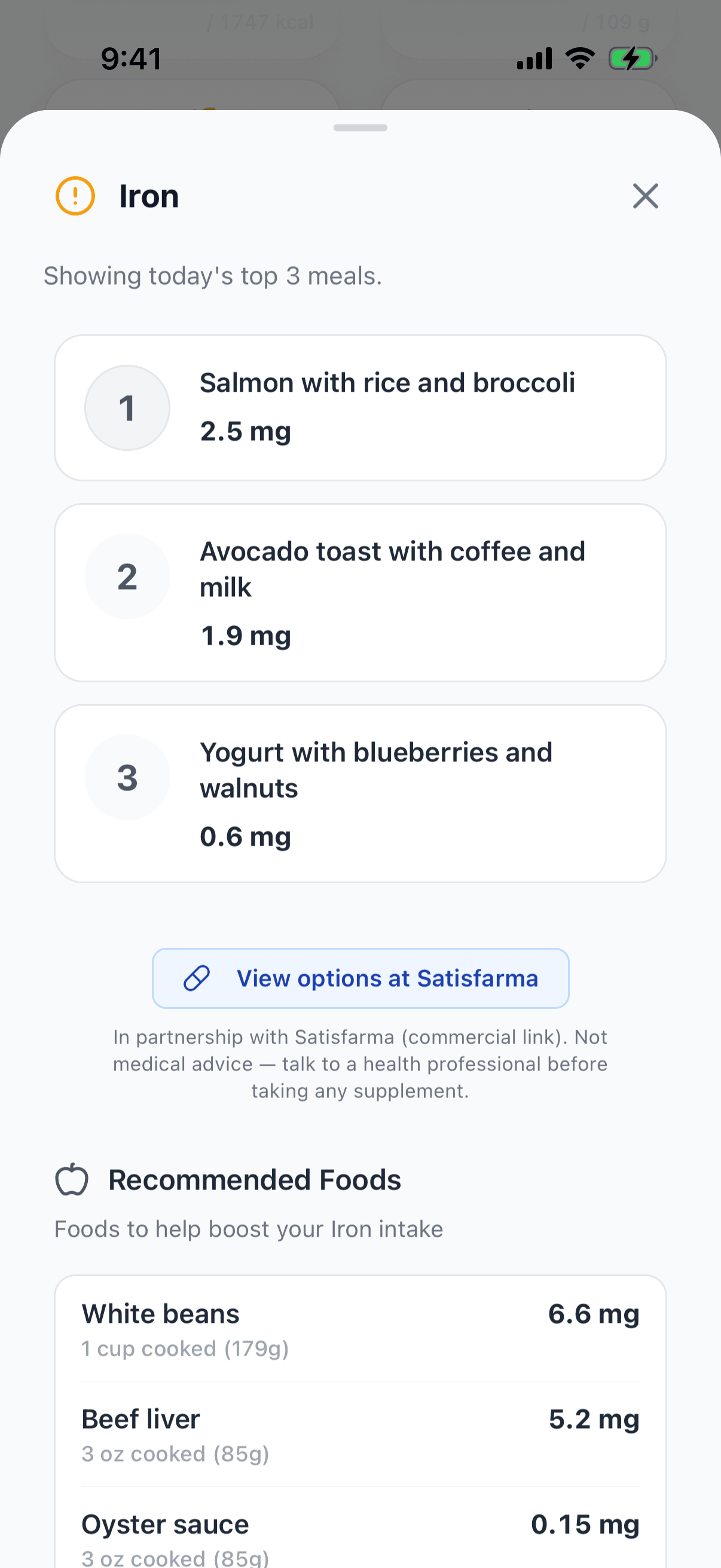
- Which meals your iron came from. The three meals (and supplements) that gave you the most iron over the period, with the milligrams from each. You see where your iron comes from, not just how much you have had.
- Which foods can raise it, with a usual portion and its iron.
- “For you, now”. When you log a meal that helps with the iron you are short of this week, vitaloop tells you. Free.
- Packaged food too. EU labels do not have to declare iron, so it rarely appears. On Pro, vitaloop estimates a packaged product’s iron from its ingredient list; where the label declares it, the label wins.
- Meal ideas that take into account the vitamins and minerals running below your reference that week (Pro).
vitaloop is made in Barcelona by Vitaloop Labs, SL, with food data that includes the dishes people actually eat in Spain. Your data is stored on EU servers, under the GDPR.
Is vitaloop for you?
If you want an app that tells you how much iron you really eat, against the European reference for your age and sex, and shows which meals it came from, vitaloop is for you.
It is free to download on the App Store and Google Play. The free plan already covers iron and the other vitamins and minerals, manual logging and the barcode scanner; Pro costs €9.90 a month or €49.90 a year, VAT included. To see everything it calculates, read which app calculates the vitamins and minerals in what you eat.
vitaloop is a personal nutrition and data-logging app developed by Vitaloop Labs, SL. It is not a medical device as defined under EU Regulation 2017/745 (EU MDR) and does not constitute professional medical advice. Personalized suggestions are based on your personal data and should not be used as a substitute for advice from a qualified healthcare professional. Nutritional data may contain inaccuracies; always verify critical information on product labels.